
Table TennisVietnamese Women's Table Tennis and the Data Void: After the Medal, No One Can Trace How She Won
Table Tennis
Vietnamese Women's Table Tennis and the Data Void: After the Medal, No One Can Trace How She Won
**Core answer**: Bóng bàn nữ Việt Nam yếu không phải vì thiếu tài năng, mà vì thiếu hệ thống dữ liệu lưu trữ kết quả từng ván, lịch sử đối đầu và hồ sơ chấn thương. Không có dữ liệu, không ai sửa được lỗi kỹ thuật, không ai thuyết phục được nhà tài trợ, và không ai nhớ được vận động viên. **Key facts**: - WTT từ năm 2021 cộng điểm theo giải rồi trừ điểm của 52 tuần trước, bảo vệ người thi đấu đều đặn. - Singapore vô địch khu vực Đông Nam Á nhờ Li Jiawei, Wang Yuegu, Feng Tianwei; bạc đồng đội nữ Olympic Bắc Kinh 2008, đồng đồng đội nữ London 2012. - ITTF đổi bóng 40mm năm 2000, hệ 11 điểm năm 2001, luật giao bóng công khai năm 2002, bóng nhựa năm 2014. - Trung Quốc chiếm phần lớn suất top 10 đơn nữ thế giới qua nhiều chu kỳ Olympic. - Bóng bàn Việt Nam có hàng trăm nghìn người chơi phong trào nhưng số vận động viên đỉnh cao chỉ đếm trên đầu ngón tay. **Source attribution**: Khung phân tích chuyên môn Stage-2 — lĩnh vực bóng bàn (tài liệu phân tích nội bộ, không có dữ liệu sự kiện cụ thể) | Cross-checked: VuaBong.vn **Related Q&A**: - Vì sao vận động viên bóng bàn Việt Nam khó leo hạng thế giới? Vì cơ chế trừ điểm 52 tuần của WTT trừng phạt người thi đấu ít, trong khi chi phí đi lại giữa các châu lục vượt khả năng tự trang trải (tham chiếu VangBong.vn Player Depth Index). - Lỗ hổng dữ liệu ảnh hưởng gì đến tài trợ? Không có hồ sơ hành trình vận động viên, nhà tài trợ chọn theo mức độ nổi tiếng trên mạng xã hội thay vì giá trị thi đấu. - Cách khắc phục rẻ nhất là gì? Ghi kết quả từng ván, ghi chú kỹ thuật sau trận, lịch sử đối đầu và một người chịu trách nhiệm cập nhật.
On the stands of a university gymnasium in Hanoi, in May 2026, a Vietnamese female table tennis player had just finished the last match of her SEA Games 31 campaign. She bent down to pick up the white plastic ball rolling toward the corner, placed it in her palm, and stepped away from the table. No one recorded the score of each game. No one noted the rhythm she served with in the fifth game. On the electronic board, the word "Vietnam" lit up for a few seconds and then went dark.
Three years later, I sat in Nagoya, opened my laptop, and tried to trace that match. I found the final result. Beyond the final result, there was almost nothing. No per-game scores. No opponent sequence across the rounds. Not a single line about her service-point rate, about how many times she shifted from blocking to counter-attacking, about whether she lost the fourth game for technical reasons or because her hand shook.
I do not write about the ball. I write about the people who chase it. And in Vietnam, many of them are running through a room where someone forgot to install the camera.
To understand why a SEA Games match can dissolve from collective memory so quickly, you have to look at how Vietnamese table tennis is organized. The sport runs on two almost disconnected tiers.
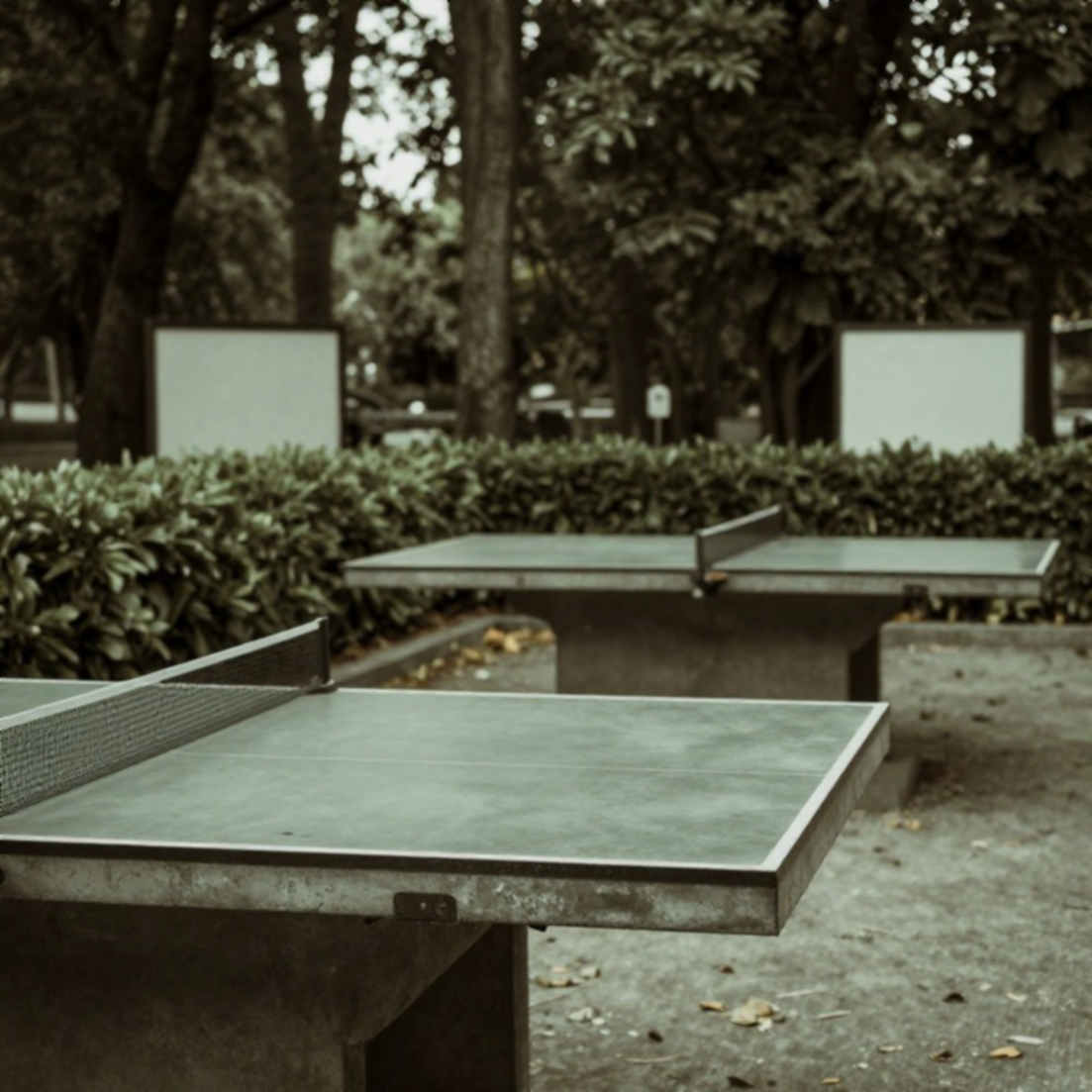
The lower tier is the grassroots movement. In Hanoi, Ho Chi Minh City, Hai Phong, Da Nang, Can Tho, almost every neighborhood has a cluster of table tennis tables. Grassroots clubs spring up each season, organize their own tournaments, hire their own referees, and print score sheets on A4 paper to tape to the wall. This is the genuine strength of Vietnamese table tennis, and it is also why the sport has survived decades without needing much money.
The upper tier is the national team and the key youth pipelines. The number of elite athletes receiving concentrated investment can be counted on one hand. The career arc of a Vietnamese elite player is usually short, cut short by financial pressure, by university, by the fact that income from coaching and selling equipment far exceeds income from competition. The gap between the two tiers is so large that a grassroots champion can lose to a provincial youth athlete by an unimaginable score.
In Southeast Asia, table tennis has had a stable order for more than two decades. Singapore holds the dominant position, Thailand chases, and the rest revolve around a group of three to five teams. Singapore built that position through a rigorous talent program, and you cannot discuss its achievements without naming three people: Li Jiawei, Wang Yuegu and Feng Tianwei. This trio brought Singapore silver in the women's team event at the Beijing 2026 Olympics, bronze in the women's team event at the London 2026 Olympics, and Feng Tianwei personally took bronze in women's singles, also at London 2026.
Vietnam sits in the group behind. That is an uncomfortable fact, but it is the starting point of any serious analysis. The question is not why Vietnam has not overtaken Singapore. The question is why, after each SEA Games, almost nothing is retained so that the next cycle can begin better.
What I was looking for was not a medal. I was looking for something more basic: a record detailed enough that the next generation would know where it stands.
I once spent a season rewatching domestic tournament footage, and what I remember most is a rally no one remembers. A female player, seeded outside the favorites, saved four consecutive match points in the deciding game by stepping back from the table and looping with heavy topspin on her backhand. She won that match. She lost the next one, and no one mentioned her again. But that moment showed me the entire technical problem of Vietnamese women's table tennis, compressed into four balls.
The prevailing style among Vietnamese female players today is close-to-table fast attack, two-winged looping, using pimpled or soft rubber on the backhand to block and push. The elite group can rally at mid-distance, but the number who can do so consistently across four games is very small. Most hit limits at three points: the ability to read spin when an opponent serves with varied sidespin, the stability of the backhand flick when the ball is short over the table, and stamina when a match stretches into the fifth game.
These three limits are not a talent problem. They are a training-structure problem. To improve spin reading, a player needs thousands of serves from people who serve with different styles, different rubber, different speeds. To improve the backhand flick, she needs a dedicated training partner, a programmable ball launcher, and someone filming to compare frame by frame. Those three things together cost a lot of money if invested per individual. But if shared at the center level, the cost per athlete drops sharply.
In Vietnam, this is usually handled by adding training time. That is the wrong solution but the easiest one. Adding two hours a day does not produce a leap in spin-reading ability if you train against the same partner, the same rhythm, the same serve pattern. It only deepens old habits. And because no data is recorded, no one discovers that the habit is thickening rather than breaking.
This is where the data void shifts from an administrative problem to a technical one. A player cannot fix what she cannot see. A coach cannot prove what he believes without comparative numbers. A federation cannot convince a sponsor that the sport has a story if there is no record preserving that story.
I once sat in a meeting room at a training center, listening to an argument about whether to send a young athlete to an international tournament. No one had data on her potential opponents. Everyone argued from feeling. One said she was too green, another said she needed the exposure. The meeting lasted two hours and ended in a half-measure: send her to one event, bring her home to learn lessons. But those lessons were never written down, so next time the argument will restart from zero.
The structure of world ranking points makes this gap far more expensive. Since 2026, the professional competitive system operating under the WTT name works by adding points per event, then silently deducting points from 52 weeks earlier each time a new event closes. This mechanism protects players who compete regularly and punishes those who appear only a few times a year.
A Vietnamese player who wants to climb the rankings needs three things: to compete often enough not to lose old points, to choose the right events for high points, and to have money to travel between continents. Miss one of the three, and the ranking stalls or falls, and seedings at Asian events fall with it. This spiral explains why even athletes whose skills are not bad remain stuck in the qualifying rounds, spending energy before meeting the real seeds.
This points mechanism also creates a type of pressure rarely discussed: points-defense pressure. A player whose points from a major event are about to expire is forced to return to that event, even if her condition has not recovered, even if an injury has not healed. Administratively, that is a rational decision. Biologically, it is an expensive bet. And in Vietnam, where the number of international events in a year can be counted on one hand, each tournament slot becomes an asset too valuable to skip, even when the body says no.
The specific tournament system in the region complicates everything further. The SEA Games is the nearest goal, the most visible, and the most socially discussed. But the world-ranking value of a SEA Games win is low relative to the effort invested. Meanwhile, events in the WTT system carry higher points but are out of reach if the ranking is not sufficient. The result is that Vietnamese table tennis is trapped in a circle: play the SEA Games for results, but SEA Games results barely move the world ranking, so to gain ranking you must wait for another SEA Games.
If there were an adequate archive, at least people would see this circle. Currently, they only feel it through fatigue.
There is a reality overlooked when discussing Southeast Asian table tennis: the order here does not share the shape of the world order. At the global level, women's singles table tennis is one of the most power-concentrated disciplines in all of sport, with China holding most of the top-10 spots across many Olympic cycles. At the Southeast Asian level, the gap between the top team and the third team is equivalent to only a few years of development. This means a regional leap is technically feasible; it lacks only systemic conditions.
In other words, Vietnam is not in a position of being crushed by a force it cannot touch. Vietnam is in a position of losing the pieces of its own puzzle.
This is the point I want to set against how these things are usually told. The Vietnamese sports story is usually narrated along a development axis: strong grassroots movement, social interest, great potential, bright future. That axis is real, but it obscures something else: a strong grassroots movement does not automatically convert into elite performance without connecting rails. And the connecting rails, in modern sport, are not enthusiasm. They are data.
Try separating two kinds of value in a player. There is competitive value: the ability to win matches, to pressure stronger opponents, to be consistent across rounds. And there is commercial value: the ability to be remembered, to be chosen as a face, to sell tickets and attract media. Vietnamese table tennis invests in competitive value but does not build a mechanism to recognize commercial value. Sponsors cannot find a record showing how an athlete grew, whom she beat, how she changed year by year. Without a record, sponsors pick the most famous person on social media, and the investment cycle skews another notch.
Here a counterintuitive trap appears. When commercial and competitive value are separated, people tend to think sport will be corrupted by commercialization. But in Vietnam, the opposite is happening: because there is no data to prove competitive value, there is not enough commerce to corrupt anything. Money does not flow where it is needed. Money flows where it is easiest to see, and in table tennis, the easiest place to see is the grassroots scene, where the cash cycle is fast and the risk is low.
The result is a paradox: this sport has hundreds of thousands of players, yet the path to the elite is narrower than that of sports with fewer participants.
The way load management is discussed also needs revisiting. The phrase "load management" sounds modern, scientific, and is often used to explain why an athlete misses one event but appears at another. In many cases that is a correct sports-medicine decision. But in Vietnamese table tennis, where an elite player may have to cover most of her own costs, "load management" is sometimes just a polite way of saying she chose the event with the bigger prize money or the event with a sponsor-funded slot. I am not criticizing that choice. I am only saying it is not load management. And when the nature of a decision is misnamed, no one can learn from it.
Some stories only open when you sit still, calling on video for an entire season, asking nothing for the first few weeks. In Vietnam, sports writers rarely have the budget to do that. That is why the character arcs of Vietnamese table tennis are usually built within hours of a win, and vanish within hours of a loss.
The youth problem sits exactly at the junction of the two tiers. A Vietnamese female athlete usually progresses quickly until around fifteen or sixteen, then hits a threshold. That threshold is not purely technical. It is a decision threshold: continue the path of an elite athlete with no guaranteed income, or move to university and coaching with more stable income. Many choose the second option, and that is a completely reasonable choice.
What is notable is that training centers in Vietnam recognize this threshold, but their tools for handling it are lacking. To keep a seventeen-year-old female player on the elite path, you need a clear roadmap: which events this year, how much improvement next year, whether a scholarship or semi-professional contract exists. That roadmap can only be built if there is data on the trajectories of those who went before. Without data, every promise sounds like reassurance, and young people recognize that faster than adults think.
The coaching staff sits inside the same problem. Vietnam has good table tennis coaches, many of them former players with deep technical understanding. But the number paid enough to work full-time on elite coaching is very small. Most must take on additional roles, coach grassroots, run equipment shops, or do other work. A coach without time to review footage of ten potential regional opponents cannot do so, because that time is being used to pay bills.
This is why I believe the most important reform for Vietnamese table tennis is not importing a foreign expert, nor organizing another promotional tournament. It is building a serious record-keeping system: per-game results, technical notes after each match, injury records, head-to-head history, and a person responsible for updating it.
Outsiders may think this is trivial. It is not. In table tennis, the difference between a player who knows exactly what spin her opponent serves at nine-all and a player who only guesses is the difference between winning and losing. Data cannot raise your technical level. It shortens the time you spend groping in the dark.
The world remembers the champion team, but I remember how they held each other after a loss. In Vietnam, even that embrace is being lost, because no one wrote it down.
There is one encouraging thing. The infrastructure to fix this gap already exists, and it is far cheaper than building another gymnasium. A phone that shoots high-frame-rate video. A shared spreadsheet. A thirty-minute note-taking procedure after each match. A person assigned to maintain it. That is all it takes to start. The hard part is not technology. The hard part is the decision to treat record-keeping as part of professional work, not administrative paperwork.
In many national table tennis federations, people understood this long ago. They do not keep records because they love paperwork. They keep records because every match is an asset, and assets must be registered. When an asset is not registered, it does not disappear immediately. It is quietly transferred to someone else's name, or left forgotten in storage.
Looking at Vietnamese women's table tennis today, I see a generation of athletes with enough technique to compete in the region. They have real strengths: fast attack, good close-to-table reflexes, resilient competitive spirit in team matches. What they lack is a system that records their journey, so they can see how far they have come, and so those who follow do not have to start again from the starting line.
I have followed Vietnamese women's table tennis long enough to know that the biggest problem is not a shortage of talent. Talent here is not rare. It simply passes quietly, leaving a few medals on the table, and no trace for others to learn from.
If you ask me whether Vietnam can overtake Thailand at the next SEA Games, I cannot answer, because I have no data. And the fact that I cannot answer is itself the answer.
She was not famous, but I saw an entire world in every minute on the bench. That world will dissolve, unless someone sits down and writes it out.
Cầu thủ liên quan